
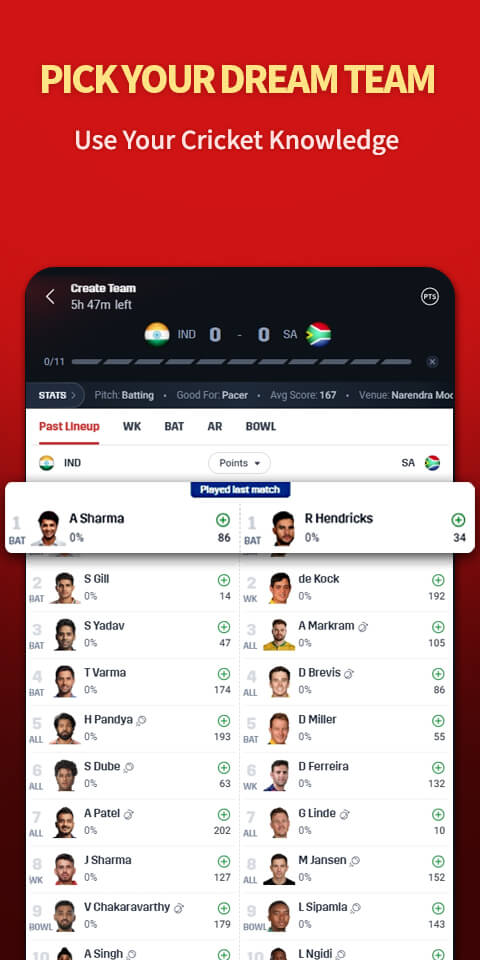
Ask someone who has played fantasy cricket for a season what changed their results most, and the answer is rarely a clever pick. It is the habit of looking at the team sheet before confirming a squad. A player who is rested, injured or simply left out scores nothing at all, and the credits spent on him are gone with no recourse.
That makes the team sheet the highest-value piece of information available, and it arrives late — usually around the toss. The practical conclusion is uncomfortable for people who like to plan: draft early if you enjoy it, but treat that draft as provisional until the eleven is known.
What the sheet actually tells you
A team sheet is more than a list of names. Read in order, it answers four questions that change selection:
| Question | What to look for | Effect on the squad |
|---|---|---|
| Who is playing at all? | Names present or absent versus the squad list | Removes anyone who cannot score; frees credits immediately |
| How is the batting ordered? | Openers and the likely number three | Top-order players are guaranteed to bat, which is the safest form of involvement |
| Who bowls, and how much? | Frontline bowlers versus part-timers | A full quota is several chances at a wicket; two overs is a cameo |
| Is there a rotation? | Rested regulars, a debutant, a specialist swap | Changes the credit map of the whole side, often in your favour |
The fourth is the one that creates opportunities. When a well-known player is rested, his replacement is usually cheap and will do the same job for the same number of overs.
Draft early, finalise late
There are two failure modes, and they are opposites. One is building a squad days in advance and never revisiting it. The other is leaving everything to the last two minutes and confirming something half-considered because the clock is running.
The middle path is to do the thinking early and the editing late.
- Draft a provisional squad when the fixture appears, purely to see where the credits go.
- Note two or three players whose inclusion you are unsure about, so you know what to check.
- Wait for the team sheet, which usually lands close to the toss.
- Remove anyone not in the eleven and spend the freed credits deliberately rather than on the first available name.
- Revisit the captain decision last, because the toss and the conditions may have changed it.
Why the order matters. People who re-pick a whole squad after the team sheet usually run out of time and make it worse. People who only patch the holes left by absentees finish with a squad that still reflects their original reasoning.
When a late change lands
Withdrawals after the sheet is announced are rarer but they happen, and they are the one situation worth watching the clock for. If a player is pulled before the lock, the credits are recoverable; afterwards they are not.


If the start is delayed, the lock moves with it. That reopens a window most people assume has closed, and it is the one time a late look is strictly free.
Once the eleven is known, the rest is arithmetic you have already done. Open a fixture and try it on the next match.
Join ₹1 Contest Now Download Hero11 APKWhat this does not solve
Knowing the eleven does not tell you who will score. It removes the errors that have nothing to do with judgement, which is a smaller claim and a more reliable one. Reading the sheet stops you losing to a problem you could have seen; everything after that is cricket.
Next in this series: what a premium pick really costs, and how the two multiplier slots are decided.
When is the team sheet usually announced?
Close to the toss for most fixtures. That is why drafting early and finalising late works better than either extreme.
What happens if I miss it and a player does not play?
He scores nothing and the credits are spent. There is no refund of credits inside a locked squad.
Does a delayed start give me more time?
Yes. The lock moves with the start, so a rain delay reopens editing. The app clock is the one to follow.
Is a rested star always a bad pick?
He is not a pick at all if he is not playing. His replacement, however, is often the best value on the card.