
A credit budget looks like a spending limit and behaves like a comparison engine. Every time you take an expensive player, you are not just deciding that he is good; you are deciding he is better than the two cheaper players his price forces you to drop elsewhere. That second half of the sentence is where most squads are won and lost.
The arithmetic nobody does
Suppose a premium batter costs roughly double a solid mid-priced one. Taking him means one other slot drops to the cheapest tier available. The question is not “will the premium batter outscore the mid-priced one”. It is “will he outscore him by more than the gap between a solid pick and a bottom-tier pick in the slot I downgraded”.
A premium pick has to beat its replacement and pay the tax it levies on the rest of the squad. Most do not.
Stated that way, a lot of famous names stop looking obvious. It also explains why squads full of stars often finish mid-table: the money is concentrated in four players and the other seven are filler who score nothing.
Where credits are usually wasted
| Habit | Why it feels right | What it costs |
|---|---|---|
| Paying for a famous out-of-form batter | Reputation and past scores | Premium price for mid-tier output, plus the downgrade elsewhere |
| Taking a lower-order finisher at a high price | Memorable cameos | He may not bat at all, wasting the slot entirely |
| Loading one side of the match | Backing the stronger team | Blocked by the per-side cap, and leaves no cover if that side collapses |
| Leaving credits unspent | Feels prudent | Nothing is saved; unspent credits score zero |
Where cheap picks come from
Reliable value appears in predictable places, and all of them come from reading the team sheet first:
- A replacement for a rested regular. Same role, same overs, a fraction of the price.
- A frontline bowler in the weaker side. He still bowls his full quota and the opposition is more likely to attack him, which creates wicket chances.
- A keeper who bats in the top order. Fielding points arrive regardless, and the batting is a bonus.
- A debutant with a defined role. Cheap because unfamiliar, not because he will not play.


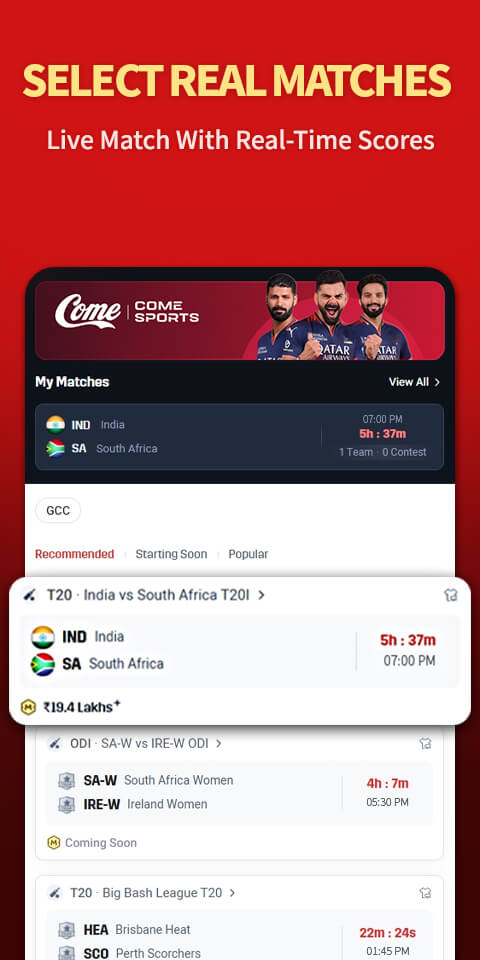
The budget is easiest to understand with a real card in front of you. Open a fixture and see where the credits actually sit.
Join ₹1 Contest Now Download Hero11 APKA simple test before confirming
Go through the squad once and, for each expensive player, name the cheaper player you dropped to afford him. If you cannot name the trade, you have not made a decision — you have made a wish list and let the builder sort it out.
Continue with the multiplier slots, where the same logic applies with far higher stakes, or squad balance and role minimums.
Should I always spend the full budget?
Yes, in practice. Unspent credits score nothing, so leaving them is a pure loss unless the only remaining options are players who will not take the field.
Are premium picks ever right?
Often, when the player is certain to be involved for a long time. The test is whether he beats his replacement by more than the downgrade he forces elsewhere.
How many premium players can a squad carry?
However many the budget allows while still filling the other slots with players who will actually play. Three premiums and seven non-contributors is a weak squad.
Is a cheap bowler from the weaker side really viable?
Frequently. He bowls a full quota and is attacked more, which creates wicket chances that a tight bowler in a dominant side may never get.